
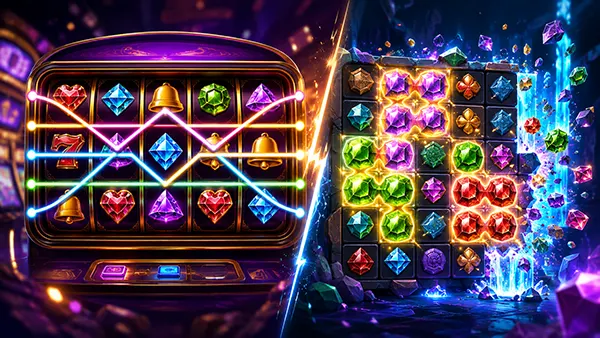
Cluster Pays vs Traditional Paylines: How the Mathematics of Winning Combinations Changes
Slot games can look similar on the screen while using very different methods to determine a winning result. Traditional payline slots compare symbols along fixed patterns that cross the reels, whereas Cluster Pays games normally look for groups of identical or matching symbols connected on a grid. That difference changes far more than the visual presentation. It affects which symbol positions matter, how wins are counted, how larger combinations develop and how features such as cascades interact with the basic game. By 2026, both models remain widely used: classic paylines continue to appear in new releases, while grid-based cluster systems have developed into increasingly varied formats. Understanding the distinction does not require complicated probability formulas. The important point is that paylines organise possible wins around predefined routes, while Cluster Pays organises them around spatial relationships between symbols.
How Traditional Paylines Define Winning Combinations
A traditional payline is a predetermined route through the reel window. On a conventional five-reel slot, the line might run straight across the middle row, move from the upper row to the centre and back again, or follow another fixed pattern specified in the game rules. A winning combination is normally created when the required number of matching symbols appears on the correct positions of that line. Many slots count combinations from the first reel towards the right, although individual games can use different rules. The essential mathematical feature is that the coordinates belonging to each payline are known before the spin begins.
This makes the process relatively easy to visualise. Consider a five-reel game with ten paylines. After the reels stop, each of those ten routes can be checked against the paytable. Three matching symbols may qualify for one payout, four for another and five for a larger one. Matching symbols elsewhere on the screen do not necessarily help. Five identical symbols scattered around the reel window can produce no standard line win if they do not occupy the required positions. Pragmatic Play’s Good Luck & Good Fortune, for example, uses a 5×3 layout and requires combinations of three or more matching symbols across ten paylines.
The number of paylines should therefore not be confused with the probability of winning or the theoretical return to player. A slot with 40 lines is not automatically four times as likely to pay as a ten-line game. Developers can change symbol frequencies, paytable values, wild behaviour, bonus contributions and numerous other elements of the mathematical model. In addition, many contemporary slots use a fixed total stake rather than asking players to select individual lines. The line count mainly describes how the reel positions are evaluated; it does not provide enough information on its own to judge how frequently the game pays or how much it returns over a very large number of rounds.
Why Position Matters More Than the Number of Matching Symbols
The easiest way to understand payline mathematics is to separate symbol quantity from symbol position. Suppose four identical symbols appear somewhere on a 5×3 reel window. Their presence alone normally does not establish a four-symbol payline win. The game first checks whether they occupy consecutive eligible positions on one of its defined lines and whether they meet any direction rules stated in the paytable. A symbol only contributes to that particular line calculation when it sits in the right place. This gives traditional line slots a strong positional structure: the route is established first, and the symbols are assessed against it afterwards.
Multiple paylines can share reel positions, so one symbol may contribute to several separate line wins during the same spin. For example, a wild in the centre of the third reel might complete one horizontal combination and two diagonal combinations simultaneously. Those wins can then be calculated separately and added together according to the game’s rules. This is one reason a screen containing relatively few high-value symbols can occasionally create several payouts. The mathematics is based not simply on how many matching symbols have landed, but on how many valid payline patterns those positions complete.
Payline layouts also allow designers to control the value of different symbol sequences quite precisely. A five-symbol combination can pay substantially more than a three-symbol combination even though both follow the same route. Wilds can substitute for selected symbols, scatters may pay outside normal lines and bonus symbols can use separate conditions altogether. The result is a layered calculation: the payline identifies an eligible route, the symbol sequence identifies the combination and the paytable determines its value. This structure remains useful because players can usually see exactly which line produced a payout without needing to interpret a large connected grid.
How Cluster Pays Changes the Mathematics of a Spin
Cluster Pays removes the need for predefined winning lines. Instead, the game checks whether enough matching symbols are touching one another according to its connection rules. A common arrangement counts horizontal and vertical contact but not diagonal contact. Play’n GO’s Contact provides a clear example: it uses a 5×7 grid and awards wins when five or more matching symbols form a connected cluster through horizontal or vertical contact. The number of matching symbols within the connected group therefore becomes more important than whether those symbols follow a route from one side of the screen to the other.
This produces a fundamentally different set of possible winning shapes. Five matching symbols could form a straight row, an L-shape, a cross, a compact block or an irregular chain and still belong to the same cluster if every required connection is maintained. In a payline game, most of those arrangements would have no special meaning unless they coincided with an active line. In a cluster game, the geometry itself determines the relationship between the symbols. The calculation is therefore based on connected areas of the grid rather than a list of fixed routes.
Cluster size usually influences the payout, although the exact calculation is game-specific. Some titles use a paytable in which progressively larger clusters correspond to larger prizes, while others add special values, wilds or modifiers to the calculation. Contact, for instance, calculates its standard cluster win using the number of matching symbols and that symbol’s assigned value. NetEnt’s Aloha! Cluster Pays uses a 6×5 layout and combines its cluster system with additional features. These examples show why “Cluster Pays” should be treated as a family of connection-based mechanics rather than as one universal mathematical formula shared by every slot.
Why Grid Size and Adjacency Rules Change the Number of Possibilities
Grid size becomes particularly important because each extra position creates additional opportunities for symbols to touch. A 6×5 layout contains 30 visible positions, while a 5×7 layout contains 35. The important change is not simply the increase in the number of cells. New positions also create more possible connections between neighbouring symbols. A matching symbol in the middle of a rectangular grid may connect to symbols above, below, left and right, while one at an edge has fewer neighbours. The probability of forming a qualifying cluster consequently depends on both symbol distribution and the structure of the grid.
The connection rules can also vary between games. Horizontal and vertical adjacency is common, but it is not the only possible design. Play’n GO’s Honey Rush Black and Yellow, released in April 2026, uses a seven-reel hexagonal grid and awards a cluster win from five or more adjacently connected matching symbols. A hexagonal arrangement changes the neighbourhood around each position compared with a conventional rectangular grid. This is a practical example of how modern Cluster Pays design can alter the underlying set of possible combinations without returning to fixed paylines.
For players, this means headline figures such as “five symbols required” cannot be compared directly across every game. Five connected symbols on one grid can represent a different probability from five connected symbols on another because the number of positions, symbol frequencies and allowed connections may differ. The same principle applies when comparing a cluster slot with a payline slot. Counting the minimum symbols required for a payout tells only part of the story. The full mathematical model also includes how often each symbol can appear, how many positions are evaluated, how winning groups are valued and which additional features can change the result.

Cascades, RTP and Volatility: What the Different Systems Really Change
Cluster mechanics are frequently combined with cascades, avalanches or symbol-removal features. After a qualifying cluster pays, the winning symbols can disappear and new symbols can fall into the empty positions. This gives the same initial paid round an opportunity to generate another result without requiring an entirely separate starting layout. If another cluster forms, the process may continue according to the game’s rules. From a mathematical perspective, this creates a sequence of linked evaluations: the first random layout is checked, eligible symbols are removed, replacement symbols appear and the modified grid is evaluated again.
Traditional paylines can also be combined with cascading reels, so cascading behaviour is not exclusive to Cluster Pays. The difference is how the new screen is evaluated. In a payline game, the replacement symbols are still checked against defined line patterns. In a cluster game, the altered grid is searched for connected groups. Multipliers, persistent wilds and other features can add further conditions during a sequence. As a result, two games with similar-looking cascades can distribute their potential payouts very differently because their basic methods of recognising a win are different.
None of this means Cluster Pays inherently offers a higher RTP than paylines. RTP is determined by the complete mathematical model and represents a theoretical long-term proportion of stakes returned through prizes under the stated rules. A concrete example is NetEnt’s Aloha! Cluster Pays, currently listed with a theoretical RTP of 96.42% and a hit frequency of 21%. Those figures belong to that specific game; they are not general Cluster Pays values. A traditional payline title can have a higher or lower RTP, just as two cluster games can differ substantially from one another. The mechanism used to identify combinations is only one part of the overall design.
What Players Should Check Instead of Counting Lines or Clusters
The paytable and game rules provide more useful information than simply knowing whether a slot uses paylines or clusters. For a line game, useful details include the number of paylines, required symbol order, direction of payment, wild behaviour and whether scatter prizes are independent of lines. For a cluster game, it is worth checking the minimum cluster size, which directions count as connections, whether diagonal contact is recognised, how larger groups are valued and whether winning symbols disappear. These rules explain what the screen must actually produce before a payout can occur.
RTP and volatility should also be considered separately from the visible winning mechanism. RTP describes a theoretical result over a very large number of rounds rather than what one person should expect during a short session. Volatility describes how payouts tend to be distributed, with higher-volatility designs generally concentrating more of their theoretical return into less frequent or more uneven prizes. Cluster games are often associated with expanding grids, cascades and multipliers, but those features do not make every cluster title high-volatility. Likewise, traditional payline slots can range from relatively steady designs to games built around rare, much larger outcomes.
The practical difference between the two systems is therefore straightforward. Traditional paylines reduce the reel window to a set of predefined routes and ask whether matching symbols occupy the correct positions along those routes. Cluster Pays treats the screen more like a connected area and asks whether matching symbols form a sufficiently large neighbouring group. That shift creates far more freedom in the shapes that can qualify, especially when large grids and cascades are involved, but it does not remove randomness or provide a mathematical advantage to the player. In regulated online gaming, outcomes still depend on the game’s tested random-number process and declared rules. The most reliable way to understand any individual slot is to read its paytable, RTP information and feature rules rather than assuming that one winning system is inherently more favourable than another.
Popular
-
How Progressive Knockout Tournament Strate...
Progressive Knockout tournaments look similar to ordinary …

-
Cluster Pays vs Traditional Paylines: How ...
Slot games can look similar on the …
-
Pay N Play Casinos: Why Instant Access Is ...
Online casinos have changed considerably over the …